
Why Is My Espresso Puck Wet and Soupy? (2026)
A wet espresso puck is caused by residual water left sitting between the coffee and the shower screen after the pump stops — and on most home machines it is normal rather than a fault. When the shot ends, pressurised water is still trapped above the puck. If your machine has no three-way solenoid valve to vent it, that water settles onto the coffee and you lift out a damp, sometimes soupy basket. It happened after your espresso was already in the cup, so it cannot have spoiled the shot.
Is a Wet Puck Actually a Problem?
In most cases a wet puck is cosmetic, because it describes the state of the basket after extraction has already finished. The espresso was pulled, measured and tasted before you ever unlocked the portafilter. Whatever the coffee bed looks like at that point cannot travel backwards into your cup.
This matters because a huge amount of home-barista anxiety is spent chasing a dry puck as if it were a quality marker. It is not. Cafes with commercial machines get dry pucks largely because those machines are built to dump residual pressure automatically, not because the barista is more skilled.
There is one exception worth taking seriously. If the wet puck arrives together with a shot that ran fast and pale, tasted thin and sour, or sprayed sideways out of a bottomless portafilter, then something genuinely went wrong during extraction — and the sogginess is a side effect, not the disease. In that case the problem is channelling or grind, which our guide to a spraying bottomless portafilter walks through step by step.
So the working rule is simple: judge the shot by weight, time and taste. Look at the puck only when the shot itself was already wrong.
Cause 1: Too Little Coffee for the Basket
Under-dosing is the single most common reason a puck turns soupy, because it leaves a deep empty gap for water to pool in. That gap between the tamped coffee and the shower screen is called headspace, and its size decides how much water ends up sitting on your puck.
Picture an 18g basket loaded with 15g. The coffee bed sits several millimetres lower than the basket was designed for, so when the pump stops there is a wide reservoir directly above it. All the residual water drains into that space and soaks the surface.
The fix is to match the dose to the basket rather than guessing by eye. Most standard double baskets are cut for 18–20g; singles are usually 7–9g. Weighing the dose fixes this in one or two shots, and it also removes the biggest source of shot-to-shot inconsistency.
| Basket | Typical dose | Result if you under-dose by 3g |
|---|---|---|
| Single | 7–9g | Very deep headspace, soupy puck |
| Double (standard) | 18–20g | Noticeably wet surface |
| Double (smaller) | 15–16g | Slightly damp, usually fine |
If you genuinely prefer a smaller dose, the better answer is a basket sized for it rather than half-filling a large one.
Cause 2: No Three-Way Solenoid Valve
If your machine has no three-way solenoid valve, a damp puck is the designed behaviour and no change to your technique will fully dry it. This is the cause most people never discover, and it explains why identical technique produces dry pucks on one machine and swamps on another.
Barista Hustle defines a solenoid valve as an electronically triggered filling valve that uses a sprung rubber seal and a magnet to control water movement through the plumbing. In a three-way configuration it does one extra job: the instant the shot ends, it opens a path that dumps the pressure and the leftover water in the group head into the drip tray.
Machines with that valve release the water. Machines without it — which includes many entry-level single-boiler and thermoblock models — simply leave it where it is, on top of your coffee.
| Machine type | Three-way valve | Expected puck |
|---|---|---|
| Commercial / prosumer group head | Yes | Firm and mostly dry |
| Mid-range home machine | Often | Damp surface, holds shape |
| Entry-level thermoblock | Usually not | Wet to soupy — normal |
The test is history, not technique. If your machine has produced a wet puck since the very first shot you ever pulled on it, that is the plumbing talking. A valve that used to vent and recently stopped is a different matter and points to a clog worth servicing.
Cause 3: Grind, Ratio and Timing
Grind only causes a wet puck when it is coarse enough to let water rush through the coffee, and in that case the shot itself will already taste wrong. This is the cause people reach for first and it is the least often correct.
When the grind is far too coarse, water finds an easy path, the shot gushes, and more liquid passes through the system in less time. You get a fast, pale, sour espresso and a sloppy basket. But notice the order: the bad shot comes first, and the wet puck follows it.
That is why the shot is the diagnostic, not the basket. If your espresso hits its target weight in the expected time and tastes balanced, your grind is fine — and grinding finer purely to dry out the puck will push you into bitterness and choking. Our guide on whether your espresso is sour or bitter covers how to read that taste feedback properly.
Ratio plays a smaller supporting role. Pulling a long shot pushes more total water through the group, so a 1:3 ratio leaves more residue behind than a 1:2. It is worth knowing, but it is not worth changing a recipe you like.
Why the Puck Sticks to the Shower Screen
A puck sticks to the screen when it swells during the shot and presses against it, then stays glued there once the pressure drops. This is the opposite problem to under-dosing, and the fix runs in the opposite direction.
Coffee expands as it absorbs water. If you have dosed generously, the bed rises through what little headspace was left and makes contact with the screen. When you release the pressure the wet, soft puck simply stays attached to the metal instead of dropping back into the basket.
Reduce the dose in half-gram steps until the puck stops touching. You can check your clearance without pulling a shot at all: tamp as normal, lock the portafilter in, then unlock it and look at the surface. A clean tamped face means you have clearance; a circular imprint of the screen means you do not.
Distribution helps here too, because an unevenly packed bed rises unevenly and one high edge is enough to catch. Levelling the grounds before tamping — with a WDT tool and then a distributor — keeps the surface flat so the whole puck expands together.
A Two-Minute Diagnostic
Work through these four checks in order and you will know within two shots whether your wet puck is normal or a symptom. Each one isolates a different cause, so do not skip ahead.
- Taste and weigh the shot first. If it hit target weight in the expected window and tasted balanced, stop here. The puck is cosmetic and nothing needs fixing.
- Check your dose against the basket. Weigh what you actually put in. If it is 2–3g under what the basket is cut for, correct that and pull again before changing anything else.
- Check the machine's history. Has it always left a wet puck, from the first shot? Then it almost certainly has no three-way valve and you are done — this is normal for the machine.
- Pull one shot through a bottomless portafilter. Even spread and a single stream means extraction is healthy. Spraying, jetting or blonding early means channelling, and now the wet puck is a real clue.
Step four is the one most people never run, and it is the most informative. A bottomless portafilter turns an invisible problem into something you can watch happen.
Tools That Help — and Ones That Do Not
The tools that actually change a wet puck are the ones that control dose and distribution; the ones that change how the puck looks afterwards do not fix the cause. It is worth being clear about which is which, because the internet routinely recommends the wrong one.
What helps: anything that makes your dose repeatable and your bed level. Weighing the dose removes the headspace problem at its root. A dosing funnel keeps every gram inside the basket instead of on the counter, which quietly protects the dose you just weighed. Even distribution and a square tamp with a proper tamper stop the high-edge problem that makes pucks stick.
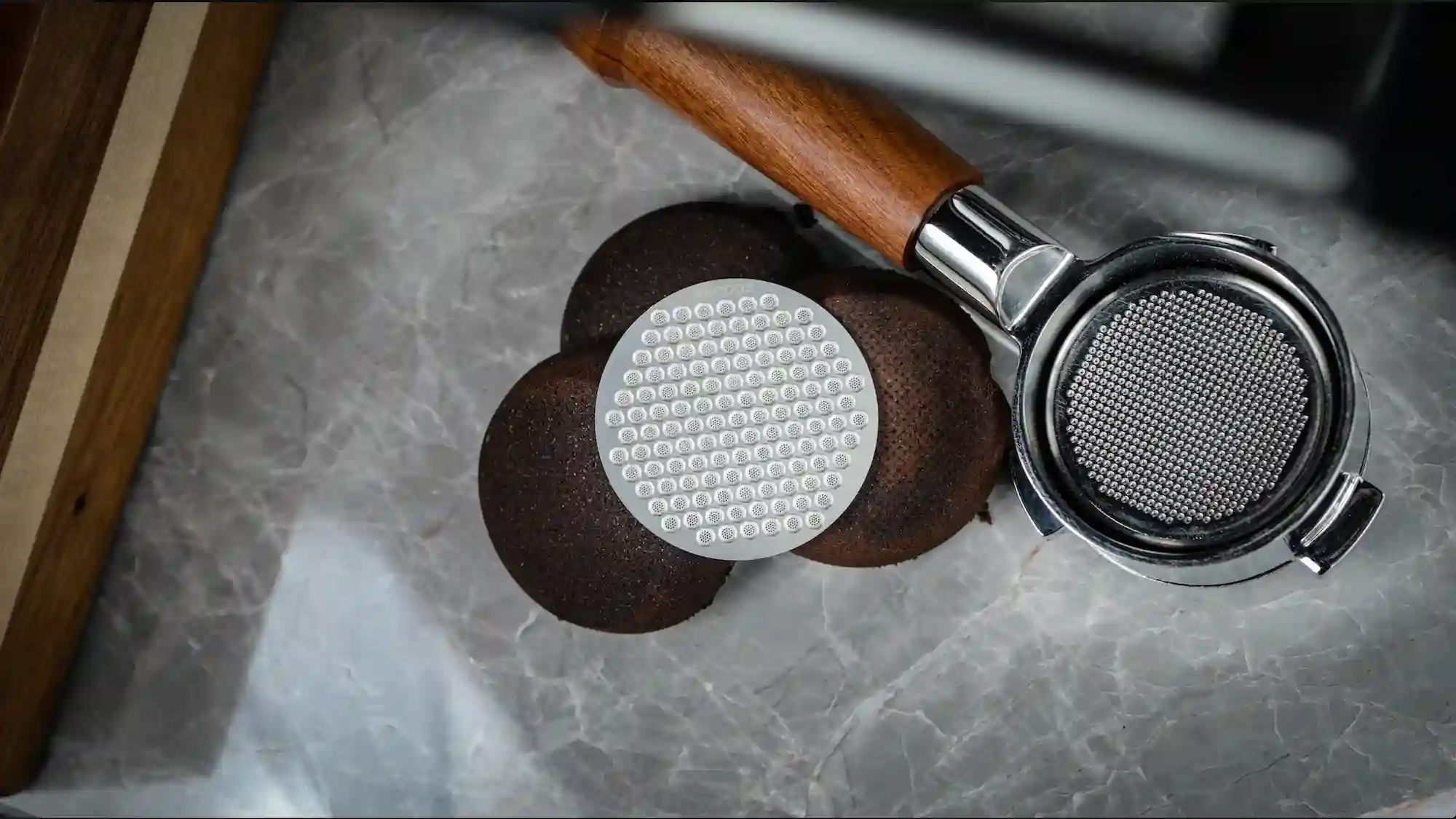
What does not help, despite its reputation: the puck screen. It is a genuinely useful accessory — ours are ultra-thin stainless mesh at $13.99 in 51mm, 54mm and 58mm — but its real jobs are keeping the shower screen clean and spreading water more evenly across the surface. It sits on top of the coffee; it does not remove the residual water underneath it. Buy it for cleanliness and distribution, not as a cure for dampness. Our guide to what a puck screen actually does goes into the detail.
For background on the coffee bed itself, Barista Hustle's glossary entry for the puck is a useful reference point. If you are unsure which sizes fit your machine at all, the machine finder matches accessories to specific models.
Common Mistakes to Avoid
- Treating a wet puck as a shot fault. It happens after extraction ends. Taste the espresso before you diagnose anything.
- Grinding finer to dry the puck. You will choke the shot and push it bitter while barely changing the moisture.
- Half-filling a large basket. If you like a smaller dose, use a basket cut for that dose instead.
- Over-dosing to close the gap. This swaps a soupy puck for one glued to the shower screen.
- Leaving the portafilter locked in after the shot. On machines without a three-way valve, water keeps dripping into the basket.
- Buying a puck screen expecting a dry puck. Useful accessory, wrong problem.
- Comparing your machine to a cafe machine. Commercial groups vent pressure automatically; most home machines do not.
- Changing several variables at once. Adjust dose alone, pull two shots, then reassess.
Frequently Asked Questions
Why is my espresso puck wet?
After the pump stops there is still pressurised water sitting in the space between the puck and the shower screen. That water has nowhere to go except onto the top of the coffee, so the puck looks wet. On machines without a three-way solenoid valve there is nothing to vent that water away, so a damp or soupy puck is the normal result rather than a fault.
Is a wet espresso puck a problem?
Usually not. A wet puck describes what happens after the shot has finished, so it cannot change what already went into your cup. Judge the shot by taste, weight and flow, not by the state of the basket afterwards. Only treat a wet puck as a symptom if it appears alongside a fast, thin, sour shot or visible spraying from a bottomless portafilter.
What is headspace in an espresso basket?
Headspace is the empty gap between the tamped surface of the coffee and the shower screen once the portafilter is locked in. Too much headspace leaves a larger reservoir for residual water to collect in, which produces a wetter puck. Too little headspace means the puck swells into the screen and sticks. A few millimetres is the usual target.
Does under-dosing cause a soupy puck?
Yes, this is the single most common cause. If you put 15g into a basket designed for 18g, the puck sits low and leaves a deep gap under the screen. Residual water pools in that gap and soaks the surface. Weighing your dose to match the basket usually tightens the puck up within one or two shots.
What does a three-way solenoid valve do?
It releases the pressure trapped in the group head once the shot ends, venting the residual water into the drip tray instead of leaving it on the coffee. Machines fitted with one tend to produce noticeably drier pucks. Many entry-level single-boiler and thermoblock machines do not have one, which is why their pucks stay wet no matter what you change.
Which machines leave a wet puck by design?
Machines without a three-way solenoid valve, which includes many entry-level single-boiler and thermoblock models. On these the puck is expected to be damp or soupy and no amount of dialling in will fully dry it. If your machine has always done this from the first shot, it is almost certainly the design rather than your technique.
Why does my puck stick to the shower screen?
Because the puck swelled during the shot and pressed against the screen, then stayed stuck when the pressure released. It usually means your dose is slightly too high for the basket, leaving almost no headspace. Drop the dose by half a gram at a time until the puck clears the screen.
Does a puck screen make the puck drier?
Not really. A puck screen sits on top of the coffee and mainly keeps the shower screen clean and helps water spread more evenly across the surface. It can make the puck easier to knock out in one piece, but it does not remove the residual water that makes a puck wet. Buy one for cleanliness and distribution, not as a fix for dampness.
Should I change my grind because of a wet puck?
Only if the shot itself is wrong. A grind that is far too coarse lets water rush through, which both ruins the extraction and leaves more water sitting around. But if your shot tastes balanced and hits your target weight in the expected time, do not chase a drier puck by changing grind. You will only unbalance a working recipe.
Does leaving the portafilter in the group head make it worse?
Yes, on machines without a three-way valve. Water can continue to drip from the group into the basket while the portafilter sits there. Knock the puck out shortly after the shot rather than leaving the portafilter locked in until your next coffee.
Why does my puck fall apart when I knock it out?
A wet puck has no structure, so it breaks up rather than dropping out as a disc. This is cosmetic. If you want a cleaner knock-out, the practical levers are matching the dose to the basket and giving the puck a few seconds to settle before you eject it.
Can the basket size cause a wet puck?
Yes. A basket rated for a larger dose than you actually use leaves permanent extra headspace. If you prefer an 15-16g dose, a basket sized for that dose will sit closer to the screen and stay tidier than an 18-20g basket filled halfway.
How do I know if a wet puck is hiding a real problem?
Look at the shot, not the basket. If the espresso runs fast and pale, tastes thin and sour, or sprays sideways when pulled through a bottomless portafilter, then you have a channelling or grind problem and the wet puck is just a side effect. If the shot tastes right and hits target weight in the expected time, the puck is irrelevant.