
Coffee Scale for Espresso: Why Every Barista Needs One (2026)
Why a Coffee Scale Matters for Espresso
Espresso brewing relies on a precise ratio between your coffee dose and the liquid yield in the cup — typically around 1:2. You put 18 grams of ground coffee in, and you aim for roughly 36 grams of espresso out. Hitting that ratio consistently is what separates a balanced, sweet shot from one that tastes sour or bitter.
The problem is that without a coffee scale, you are guessing both numbers. Volumetric measurements do not work for espresso because crema inflates the visual volume of the shot, and different beans at different roast levels produce different densities. As Barista Hustle's Espresso Compass demonstrates, small changes in dose and yield push your shot along predictable flavor axes — more extracted, less extracted, stronger, weaker. A scale is how you navigate that map intentionally instead of randomly.
Even a 0.5 gram change in dose shifts your extraction percentage enough to taste. On an 18g dose, that is less than a 3% change in weight — invisible to the eye but obvious on the palate. This is why professional baristas weigh every single dose and every single shot, and why a reliable espresso scale with timer is considered essential equipment, not optional.
Key Features to Look for in an Espresso Scale
Not every scale works for espresso. Here is what actually matters when choosing one.
Other useful features include water resistance (espresso prep is inherently messy), a heat-resistant pad to protect the scale from hot cups, and USB-C rechargeable batteries that save you from constantly swapping cells.
Espresso Scale vs. Kitchen Scale — What Is the Difference?
A kitchen scale and an espresso scale both weigh things, but the similarities end there. Kitchen scales typically measure in 1-gram increments, which is fine for baking but far too coarse for espresso. A 1g error on a recipe that calls for 500g of flour is 0.2% — negligible. A 1g error on an 18g espresso dose is 5.5% — enough to wreck your shot.
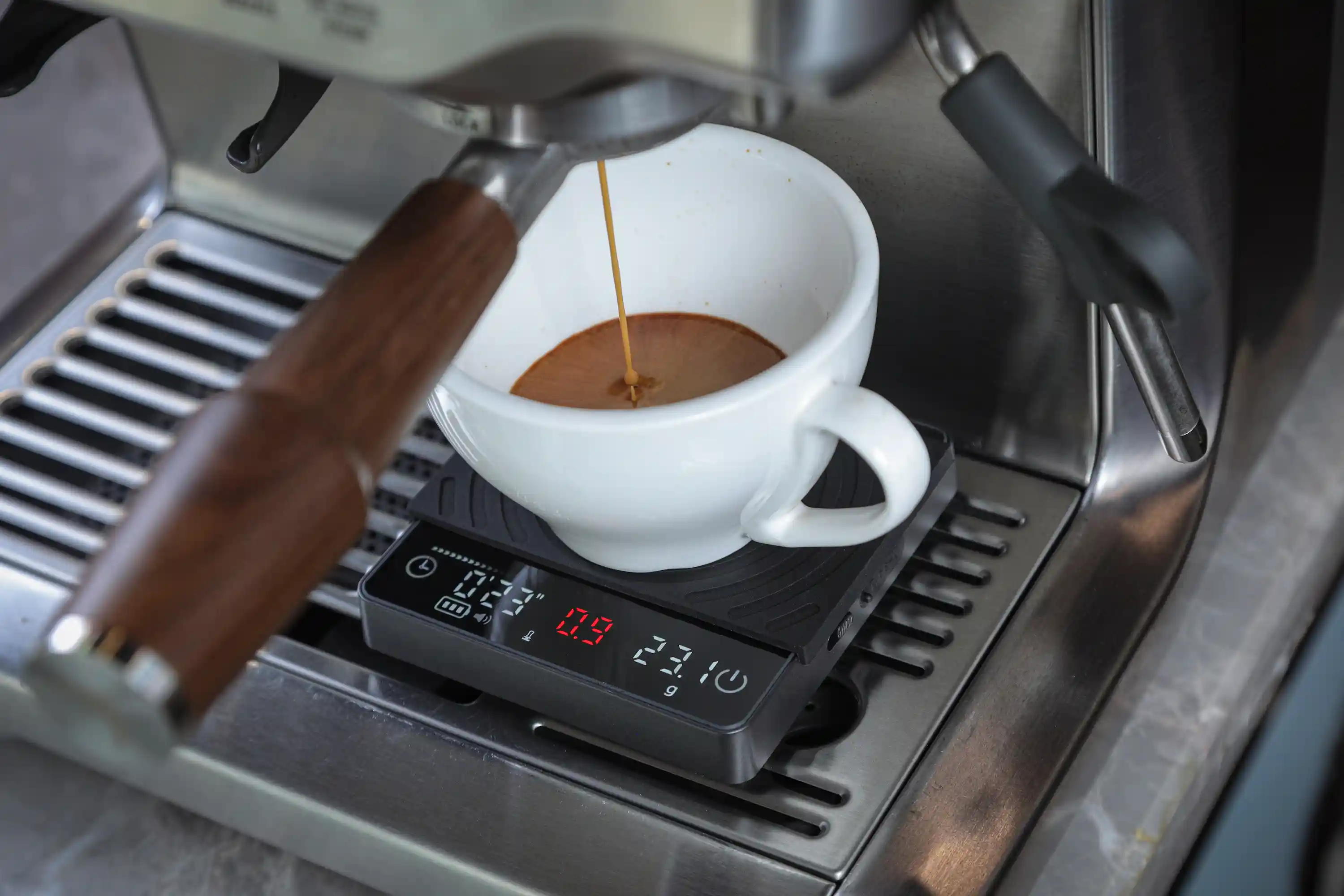
Beyond precision, kitchen scales lack the features that make espresso brewing efficient. No built-in timer, no auto-tare, no auto-start. You end up juggling a separate stopwatch on your phone while trying to watch the scale readout and the shot at the same time. A dedicated espresso scale consolidates everything into one glance.
Size matters too. Most kitchen scales are 15-20 cm wide — they physically do not fit under an espresso machine drip tray. Espresso scales are purpose-built to sit in that tight space with a cup on top.
How to Use a Coffee Scale for Espresso
Using a scale for espresso involves two weighing steps: dose and yield.
Weighing your dose: Place your portafilter (or dosing cup) on the scale, tare to zero, and grind until you hit your target weight. For most setups, this is between 17-20g depending on your basket size. A dosing funnel on the portafilter prevents spillage during this step.
Weighing your yield: Place your cup on the scale on the drip tray, tare to zero, and start your shot. On a smart scale like the KNODOS, the timer auto-starts when espresso begins flowing. Watch the weight climb toward your target — for a 1:2 ratio with an 18g dose, you stop the shot when the display reads around 36g. Total shot time should fall in the 25-35 second range for most recipes.
The beauty of weighing both ends is repeatability. When you pull a great shot, you know exactly what produced it: 18.0g in, 36.2g out, 28 seconds. When tomorrow's shot tastes different, the scale data tells you what changed — and the SCA's coffee standards give you the framework to understand why extraction targets matter.
Beyond Espresso: Pour Over, Drip, and Matcha
A good coffee scale is not limited to espresso. Pour over brewing benefits from a scale even more than espresso does, because you are manually controlling the water flow and need real-time feedback on how much water you have added and at what rate.
For pour over, look for a scale with a flow rate indicator — it shows how fast you are pouring in real time, helping you maintain a consistent stream. Dedicated pour over modes that track your water-to-coffee ratio take the mental math out of the process entirely. Instead of calculating "I need 270g of water for my 18g dose," the scale monitors the ratio for you.
Matcha preparation also benefits from scale precision. A traditional matcha serving uses just 1-2g of powder — without a 0.1g scale, you cannot dose consistently. The same applies to any concentrated beverage where small weight changes produce noticeable flavor shifts.
Espresso Scale Comparison: KNODOS vs Acaia Lunar vs Timemore Nano
Three scales dominate the espresso market in 2026 — each at a different price point with different trade-offs. Here is how they compare on the specs that actually matter for espresso brewing.
| Feature | KNODOS Smart Scale | Acaia Lunar | Timemore Black Mirror Nano |
|---|---|---|---|
| Price | ~$40 | ~$250 | ~$99 |
| Precision | 0.1g (0.3–999.9g) | 0.1g (optional 0.01g) | 0.1g |
| Max Capacity | 2000g | 2000g | 2000g |
| Size | 100 × 100 × 20 mm | 105 × 105 × 15 mm | 100 × 115 × 20 mm |
| Weight | ~180g | 265g | 230g |
| Modes | 4 (Basic, Espresso, Pour Over Ratio, Pour Over Weight) | Multiple espresso + auto modes | 3 (Standard, Espresso, Pour Over) |
| Auto-Tare | Yes | Yes | Yes |
| Auto-Start Timer | Yes | Yes | Yes |
| Flow Rate | Yes (real-time g/s) | Yes (LED bar indicator) | Yes |
| Battery | USB-C Li-ion, 90-day standby | USB-C Li-ion, 30–40 hrs active | USB-C Li-ion, ~15 hrs active |
| Water Resistant | Splash-resistant surface | Full water-resistant (submersible) | Surface waterproof only |
| Material | Matte finish composite | Anodized aluminum | Acrylic + metal |
| Bluetooth / App | No | Yes (Acaia app) | No |
| Heat Pad Included | Yes (dual-purpose silicone) | Yes | Yes |
| Display | Backlit LCD | 8-digit LED, dual display | Angled hidden LED |
Which Scale Should You Buy?
Acaia Lunar ($250) is the industry standard — used in cafés worldwide. Its 0.01g optional resolution, full water resistance, Bluetooth data logging, and aluminum build justify the price for professional baristas or serious home enthusiasts who want the absolute best. If you already own a $2,000+ espresso machine, the Lunar matches that investment level.
Timemore Black Mirror Nano ($99) sits in the middle. Its angled display is a genuinely clever design — easier to read when the scale sits under a portafilter. Build quality is solid and battery life is reasonable. A good choice if you want more refinement than a budget scale but cannot justify the Lunar's price.
KNODOS Smart Scale (~$40) delivers the core features that matter — 0.1g precision, auto-tare, auto-start timer, flow rate indicator, and 4 brewing modes — at a fraction of the price. It does not have Bluetooth or 0.01g resolution, but for the vast majority of home baristas, those features are unnecessary. The 90-day standby battery life is the longest of the three, and the dual-purpose silicone pad is a thoughtful detail. If you are building a complete espresso setup on a budget, the KNODOS scale lets you allocate more of your budget to tools that have a bigger impact on shot quality — like a better tamper or bottomless portafilter.
Why Choose the KNODOS Smart Coffee Scale?
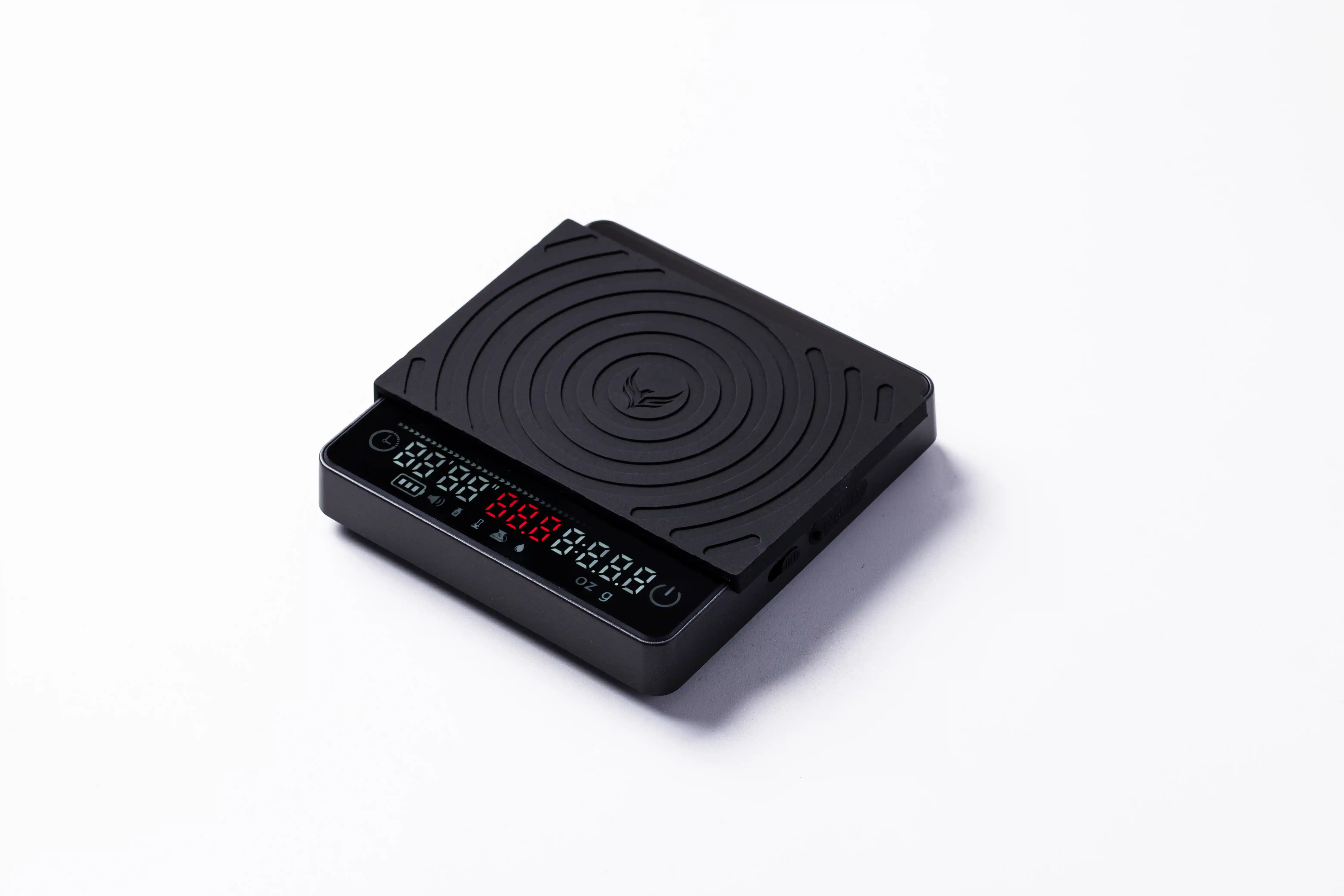
We designed the KNODOS Smart Coffee Scale to handle every brewing method from one compact device. It packs 4 intelligent modes into a 10x10x2 cm body — Basic for general weighing, Espresso mode with auto-tare and auto-timer, and two Pour Over modes (ratio tracking and weight tracking) with a real-time flow rate indicator.
In Espresso mode, the workflow is hands-free. Place your cup, and the scale automatically tares. Start your machine, and the scale detects the first drops of espresso and begins timing — no button press needed. You get 0.1g precision across the 0.3-999.9g range, with 1g precision up to 2000g for larger brewing methods.
The included removable silicone heat-resistant pad is a thoughtful detail. On one side, it protects the scale surface from hot cups straight off the machine. Flip it over, and it cradles your portafilter for stable dosing. It is the kind of dual-purpose design that makes your coffee corner less cluttered.
Battery life is another area where the KNODOS scale stands out. The USB-C rechargeable Li-ion battery lasts up to 90 days on standby with auto-sleep enabled — no drawer full of dead AAA batteries. The matte finish and premium backlit display keep the scale readable in any lighting condition, from a dim morning kitchen to a bright café counter.
KNODOS Smart Coffee Scale
- Precision: 0.1g (espresso) / 1g (up to 2000g)
- Modes: Basic, Espresso (auto-tare + auto-timer), Pour Over Ratio, Pour Over Weight
- Size: 10 x 10 x 2 cm (4 x 4 x 0.8 in)
- Battery: USB-C rechargeable, 90-day standby
- Extras: Flow rate indicator, silicone heat-resistant pad, backlit display
Frequently Asked Questions
Do I really need a scale for espresso?
Yes. Espresso uses a precise coffee-to-water ratio (typically 1:2) that determines whether your shot tastes balanced, bitter, or sour. Without a scale, you are guessing your dose and yield every time. Even a 0.5g difference in dose can noticeably change extraction. A scale removes guesswork and makes your shots repeatable.
What precision do I need for an espresso scale?
You need at least 0.1g precision for espresso. Kitchen scales that measure in 1g increments are not accurate enough — a 1g error on an 18g dose is a 5.5% deviation, which significantly affects extraction. For pour over and drip coffee, 0.1g is ideal but 1g can work.
What is the best size for an espresso scale?
The scale must fit under your espresso machine's drip tray with a cup on top. Most drip trays have limited vertical clearance, so a thin profile matters. The ideal size is around 10x10 cm (4x4 inches) with a height under 2 cm. Anything larger may not fit, and anything smaller may not support your cup stably.
What is auto-tare on a coffee scale?
Auto-tare automatically zeroes the scale when you place your cup, so the display shows only the weight of the liquid being added. This means you do not need to press any buttons during your shot — the scale detects the cup, tares, and is ready to weigh your espresso yield.
Can I use a coffee scale for pour over and drip brewing too?
Absolutely. A good coffee scale works across all brewing methods. Look for one with dedicated pour over modes that track flow rate and brew ratio in addition to espresso mode. The KNODOS Smart Coffee Scale offers 4 modes covering espresso, pour over (ratio and weight), and basic weighing — one scale for every method.
Related Guides
- Single Dose Coffee Bean Storage Tubes — Weighing pairs naturally with pre-portioned single doses.
- How to Tamp Espresso Like a Pro — Once the dose is right, the tamp decides the shot.
- What Is an Espresso Tamping Station? — Where the scale, tamper and tools live on the counter.