
53.3mm vs 54mm Tamper for Breville: Which Size Fits? (2026)
For a Breville or Sage machine with a 54mm portafilter, the right tamper has a base of about 53.3mm — a tamper that is genuinely 54mm wide is wider than the inside of the basket and will not reach the coffee. The “54mm” printed on the machine describes the portafilter size class, not the space your tamper has to fit into. That is why nearly every tamper sold for Breville 54mm machines actually measures between 53mm and 53.3mm, and why those decimals matter: the closer the base comes to the basket wall without catching it, the smaller the ring of loose coffee left at the edge for water to rush through. It is also how we build our own tools: every KNODOS tamper and distributor sold as 54mm for Breville is named for the portafilter it fits and machined on a 53.3mm base for a snug fit in the basket.
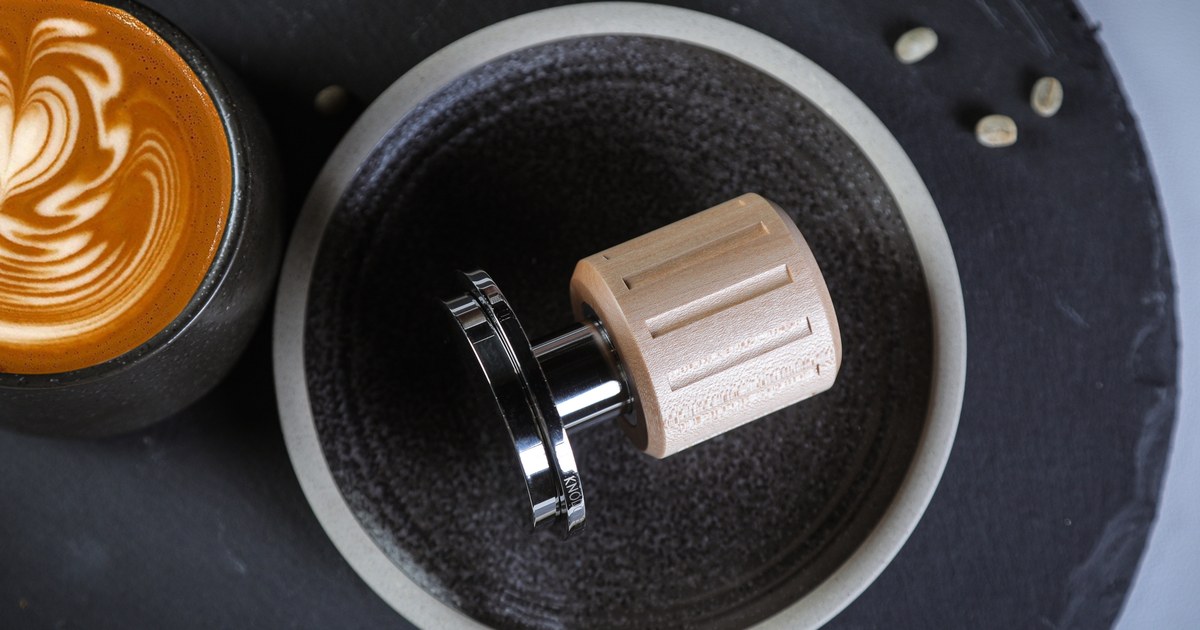
The Short Answer: What Size Tamper Fits a Breville 54mm Portafilter?
Choose a tamper with a base of 53.3mm for a snug fit in a stock Breville 54mm basket; a 53mm base works but leaves a wider gap at the wall, and a true 54mm base does not fit at all. That single number covers Breville’s most popular home machines — the Barista Express, Barista Pro, Barista Touch, Bambino, Bambino Plus, Infuser and Duo Temp Pro — and the identical Sage-branded machines sold in the UK and Europe.
The confusion starts with the search box. Owners type “54mm tamper” because that is the number Breville prints, and sellers name their products the same way. A listing that says “54mm” and nothing else is telling you which portafilter the tamper is meant for, not how wide the base is.
| Tamper base | Fits a stock Breville 54mm basket? | What to expect |
|---|---|---|
| 53.0mm | Yes | Drops in easily; leaves the widest edge gap of the common sizes |
| 53.3mm | Yes | Close fit with a small edge gap; a widely sold precision size |
| 54.0mm (true width) | No | Wider than the basket interior; catches before it reaches the coffee |
| 58mm | No | A different size class, used on the Oracle and Dual Boiler |
Why a “54mm” Tamper Is Not 54mm Wide
54mm is the nominal size of the portafilter and basket, while a tamper has to fit the interior of the basket at coffee level, which is narrower because the basket wall has thickness and tapers slightly toward the floor. Retailers and tamper makers commonly quote the internal diameter of Breville’s 54mm baskets at roughly 53 to 53.5mm, and the basket narrows slightly toward its floor. A base that matched the rim would bind against the sides long before it reached the grounds.
Barista Hustle states the principle clearly in its lesson on tamping: the most effective tampers fit snugly, “not so wide as to get lodged against the sides of the basket but not too loose-fitting either.” For the majority of 58mm baskets it recommends a window of about 58.3 to 58.5mm, and warns that at 58.0mm the chance of water travelling down the side of the basket increases sharply. The same principle applies to Breville’s smaller basket: the base should sit just under the internal diameter, close enough to leave a minimal gap without catching, not at the number printed on the machine.
So a product called “54mm tamper for Breville” is not lying — it is naming the portafilter it fits. The honest specification is the base diameter, and for Breville that figure should begin with 53. Our own guide to choosing espresso accessories for your machine walks through the 51mm, 54mm and 58mm size classes if you own more than one machine.
How Much Coffee Does the Edge Gap Leave Untamped?
The gap looks tiny in millimetres, but it runs all the way around the puck: in a basket measuring 53.5mm inside, a 53mm tamper leaves about two and a half times the untamped edge area of a 53.3mm tamper. This is arithmetic, not a lab test, so treat it as geometry rather than a measurement. Take an example basket with a 53.5mm internal diameter at tamping height and subtract the area of the tamper face from the area of the coffee bed.
| Tamper base | Gap at each side | Untamped ring | Share of the puck surface |
|---|---|---|---|
| 53.0mm | 0.25mm | about 42 mm² | about 1.9% |
| 53.3mm | 0.10mm | about 17 mm² | about 0.75% |
That ring sits against the basket wall, which is already the weakest point of the puck: the coffee there is pressed against smooth steel rather than against more coffee, and a loosely tamped band gives water an easy route down the side. Water under pressure takes the path of least resistance, so a loose edge can drain a share of the shot that bypasses the centre of the bed. On a bottomless portafilter this often shows up as early, pale streams at the edge — the pattern we describe in our guide to fixing bottomless portafilter spraying.
Two honest caveats. If your basket measures a little smaller inside, say 53.4mm, every number in the table shrinks, but the order stays the same. The edge of the base matters too: Barista Hustle notes that tamper bases should not have any visible edge radius, meaning no rounded-off edge.
53mm vs 53.3mm: Do a Few Tenths Matter?
Yes, if you use a single-wall basket and care about shot-to-shot consistency: moving from 53mm to 53.3mm removes more than half of the edge gap in the example above, while the tamper still drops into a stock basket without catching.
A 53mm base is the forgiving option. It drops into any Breville basket without thought. The cost is the wider gap at the wall, which matters most when you are already chasing channeling.
A 53.3mm base is a widely sold precision size for Breville, closer to the wall than 53mm. It closes most of the gap while still sliding in cleanly, which is why it is the size we use on our V2 calibrated tampers, our Echo click tampers and our 54mm distributors.
Going wider is not automatically better. A base wider than your basket drags on the wall or stops short of the coffee, which defeats the purpose, so we build our 54mm tools at 53.3mm for a snug, repeatable fit.
Base shape is the other half of the decision: our V2 tampers use a ripple base and our Echo tampers use a flat base.
Which Breville and Sage Machines Take a 53.3mm Tamper?
Every Breville and Sage home machine with a 54mm portafilter takes the same 53.3mm tamper; the Oracle, Oracle Touch and Dual Boiler are the exceptions, because they use 58mm portafilters. Sage is the name Breville uses in the UK and much of Europe, so a Sage Barista Express and a Breville Barista Express share the same basket and the same tamper.
| Machine | Portafilter | Tamper base to look for |
|---|---|---|
| Barista Express | 54mm | 53.3mm |
| Barista Pro | 54mm | 53.3mm |
| Barista Touch | 54mm | 53.3mm |
| Bambino / Bambino Plus | 54mm | 53.3mm |
| Infuser | 54mm | 53.3mm |
| Duo Temp Pro | 54mm | 53.3mm |
| Oracle / Oracle Touch | 58mm | about 58.3mm |
| Dual Boiler | 58mm | about 58.3mm |
The Impress models are a special case. The Barista Express Impress and Barista Touch Impress tamp with a built-in assisted lever, so a hand tamper is optional on those machines, and we do not list our 54mm hand tampers for them.
If you are unsure which portafilter your machine uses, our machine finder lists the size by model. For a wider look at upgrading these machines, see our buyer’s guide to the best espresso accessories for Breville.
How to Check Your Tamper Fit at Home
You do not need calipers to check fit: an empty-basket drop test, a look at the edge of the tamped bed, and a shot through a bottomless portafilter will tell you whether a tamper is too small or too big.
- The drop test. Lower the tamper into a clean, dry, empty basket. It should slide down without catching on the wall. If it stops at the rim or needs pushing, it is too wide for your basket.
- The wobble test. With the tamper resting inside, feel how far it moves from side to side. A little play is normal at any size; a clear rattle is a sign of a small base.
- The edge check. After tamping a dose, look at the edge of the bed. A raised ridge or loose grounds at the wall that the tamper never touched means the base is not reaching far enough.
- The shot check. On a bottomless portafilter, watch the first seconds of extraction. Pale streams or spurts that start at the edge of the basket point to water running down the wall.
If you do own calipers, measure the inside of the basket at the height where the tamper meets the coffee, not at the rim, because the wall tapers. Then choose the closest base that still sits just under that figure — about 0.2mm below in the example above.
Keep in mind that a perfect fit cannot rescue a clumpy or uneven bed. If the edge is fine and the shot still channels, look at distribution first: our guides to the WDT tool and the espresso distributor cover the two steps that come before the tamp.
Does Tamper Size Matter More Than Tamping Pressure?
For edge channeling, fit matters more than force: once coffee is compressed, pressing harder changes the puck very little, but a gap at the wall stays a gap however hard you push.
Barista Hustle measured the pressure side of this. In the same tamping lesson, it compared a comfortable tamp with a very heavy one and found a difference of only 3% in how far the puck compressed. Grounds stop moving after a small amount of pressure, so extra force mostly goes into your wrist.
That does not make pressure irrelevant; it makes consistency the goal. A Barista Guild of America survey published by the Specialty Coffee Association found that most respondents tamped at 20 to 30 pounds, while 22% answered “other” — they never measured, used mechanical tamping devices, or tamped until the puck was evenly dense. What hurts is changing the force from one shot to the next.
A calibrated spring tamper solves that by delivering the same force every time, and a self-leveling base stops the tamp from going in at an angle, which creates its own uneven density. Our V2 tampers ship with 20, 25 and 30 lb springs, and our Echo tampers click at 30 lb with a 20 lb spare — all inside the range the survey found. For technique, our full guide on how to tamp espresso covers stance, levelness and the most common errors.
KNODOS 54mm Tampers and Distributors: Built on a 53.3mm Base
Every KNODOS tool we sell as 54mm for Breville — tampers and distributors alike — is named for the portafilter it fits and built on a 53.3mm base for a snug fit in the basket: the V2 calibrated tampers, the Echo click tampers and the 54mm distributors. All of them are made for Breville 54mm portafilters such as the Barista Express, Pro, Touch, Bambino Plus, Infuser and Duo Temp Pro, and they fit the same machines sold as Sage.
| Model | Base | Mechanism | Springs | Price |
|---|---|---|---|---|
| V2 calibrated (walnut, maple, rosewood) | 53.3mm ripple base | Spring-loaded, self-leveling | 20, 25 and 30 lb | $49.99 (on sale for $43.99 at the time of writing) |
| Echo click (walnut, maple, rosewood, olive wood, oak) | 53.3mm flat base | Click at target pressure, self-leveling | 30 lb click, 20 lb spare | $49.99 |
| Echo click, blackwood | 53.3mm | Click at target pressure, self-leveling | 30 lb click, 20 lb spare | $55.00 |
| 54mm distributor (walnut, maple, rosewood) | 53.3mm base | Adjustable-depth leveler | — | $39.99 |
Choosing between them comes down to how you like to know you are done. The Echo click tampers give a single audible click when the spring reaches its target force, which suits anyone who wants a clear stop signal. The V2 line, including the walnut 54mm V2 tamper, gives you three interchangeable spring weights — 20, 25 and 30 lb — so you can choose the force that suits you. The walnut Echo 54mm pairs the click with a flat base and a solid walnut handle. You can compare every option on our tampers page.
The 54mm distributors follow the same rule as the tampers. A distributor spins on top of the grounds, so a base sized close to the basket wall levels the bed right out to the edge instead of leaving a ridge there, and its depth adjusts to your dose. Used together, a 53.3mm distributor and a 53.3mm tamper treat the same diameter of coffee, one after the other.
A tamper is one step in the 54mm workflow. The distributor levels the bed before you tamp, a WDT tool breaks up clumps, and an espresso tamping station holds the portafilter level while you work. For the Oracle and Dual Boiler, choose our 58mm tampers instead, which use a 58.3mm-class base.
Common Mistakes to Avoid
- Buying by the headline number. “54mm” in a product title names the portafilter. The base diameter in the specifications is the number that decides fit.
- Assuming bigger is always better. A true 54mm base is wider than a Breville basket interior. The goal is the closest fit that still drops in cleanly.
- Measuring the rim. The basket tapers, so a rim measurement overstates the space at coffee level. Measure where the tamper meets the grounds.
- Tamping harder to cover a small base. Extra force barely changes the puck and does nothing for the loose ring at the wall.
- Blaming the grinder first. If shots channel at the edge, check tamper fit and distribution before changing the grind.
- Forgetting the 58mm Brevilles. The Oracle, Oracle Touch and Dual Boiler take a 58mm tamper, not a 53.3mm one.
Frequently Asked Questions
What size tamper do I need for a Breville Barista Express?
A tamper with a base of about 53.3mm. The Barista Express uses a 54mm portafilter, but the inside of the basket at coffee level is narrower than 54mm, so tampers sold for it measure between 53mm and 53.3mm. A 53.3mm base is a widely sold precision size and leaves a smaller edge gap than a 53mm base.
Will a true 54mm tamper fit a Breville 54mm portafilter?
No. A base that genuinely measures 54mm is wider than the interior of a Breville 54mm basket, which retailers and tamper makers commonly quote at roughly 53 to 53.5mm inside. It catches on the wall or the rim before it reaches the grounds. Tampers labelled 54mm for Breville are almost always describing the portafilter they fit, not their real width.
Is a 53.3mm tamper better than a 53mm tamper for Breville?
For a single-wall basket, usually yes. In a basket measuring 53.5mm inside, a 53mm base leaves a 0.25mm gap on each side, while a 53.3mm base leaves 0.10mm. That cuts the untamped ring at the wall by more than half. A 53mm tamper still works, but it gives water an easier path down the side of the puck.
Why are KNODOS 54mm tampers built on a 53.3mm base?
Because a Breville 54mm basket is narrower inside than 54mm. A 53.3mm base reaches close to the basket wall for a snug fit, leaving less loose coffee at the edge than a 53mm base, while still dropping into a stock basket without catching. The 54mm in the name tells you which portafilter it fits; the 53.3mm base is what does the work.
Are KNODOS 54mm distributors also 53.3mm?
Yes. Our distributors sold as 54mm for Breville are named for the portafilter they fit, like our tampers, and use a 53.3mm base so they reach close to the basket wall. All of them have adjustable depth and fit the Barista Express, Pro, Touch, Bambino Plus, Infuser and Duo Temp Pro.
Does a 53.3mm tamper fit the Breville Bambino Plus?
Yes. The Bambino and Bambino Plus use the same 54mm portafilter size as the Barista Express, Pro, Touch, Infuser and Duo Temp Pro, so the same 53.3mm tamper fits all of them. Sage sells these machines under its own name in the UK and Europe, and the sizing is identical.
What size tamper does the Breville Oracle or Dual Boiler use?
A 58mm tamper. The Oracle, Oracle Touch and Dual Boiler use 58mm portafilters, a different size class from the rest of the Breville range. Look for a base of around 58.3mm for a close fit in a standard 58mm basket. A 53.3mm tamper is far too small for these machines and will leave a wide loose ring.
Can I use a 58mm tamper on a Breville Barista Pro?
No. The Barista Pro takes a 54mm portafilter, and a 58mm tamper is about five millimetres wider than its basket, so it will not go in at all. Use a tamper with a base of about 53.3mm. If you are not sure which size your machine uses, the KNODOS machine finder lists it by model.
How do I know if my tamper is too small?
Drop it into the empty basket and feel for side-to-side play; a clear rattle suggests a small base. After tamping, look for a ridge or loose grounds at the wall that the tamper never touched. On a bottomless portafilter, early pale streams or spurts at the edge of the basket point to channeling at the wall.
Does tamping pressure matter more than tamper size?
Not for edge channeling. Barista Hustle measured only a 3% difference in puck compression between a comfortable tamp and a very heavy one, so pressing harder changes the puck very little. A gap at the wall stays a gap however hard you push. Get the fit right first, then aim for consistent pressure.
How hard should I tamp with a 53.3mm tamper?
In a Barista Guild of America survey published by the Specialty Coffee Association, most respondents tamped at 20 to 30 pounds. What matters more than the exact number is repeating it. A calibrated spring tamper delivers the same force every time, which removes pressure from the list of variables when you dial in.
Will a 53.3mm tamper fit an aftermarket precision basket for Breville?
Check it before you rely on it. An aftermarket basket made for Breville portafilters may not match the stock basket inside, so do the empty-basket drop test before your first shot: the tamper should slide down without catching and sit level without a noticeable rattle.