
What Is a WDT Tool and Do You Need One? (2026)
What Is a WDT Tool?
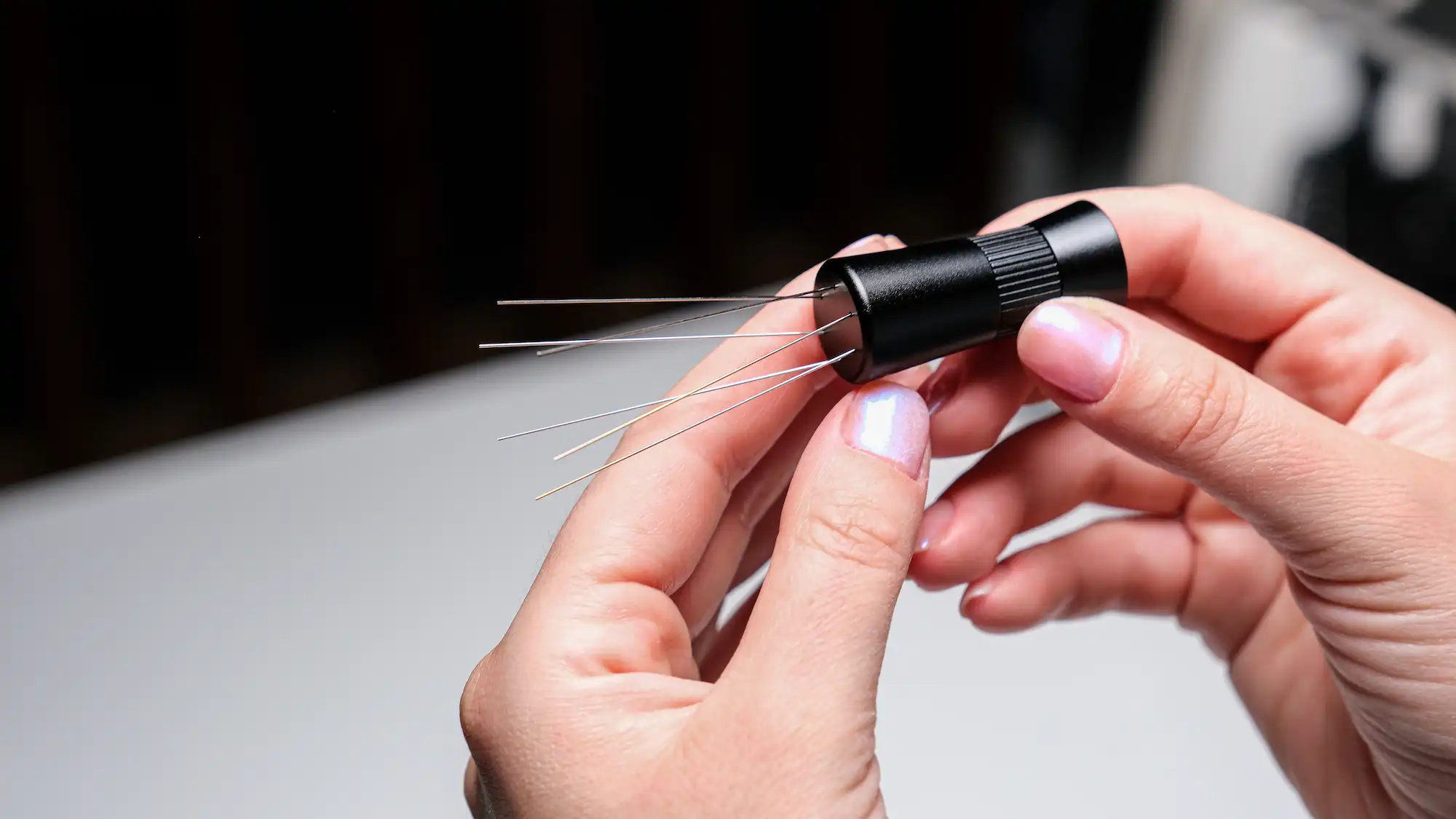
A WDT tool is a handle fitted with several fine needles that you use to stir your coffee grounds inside the portafilter before tamping. The needles reach down through the dose and break up clumps, mixing dense and loose pockets into one uniform bed so water can flow through the puck evenly during extraction. WDT stands for the Weiss Distribution Technique, named after John Weiss, who popularized the method.
It sounds almost too simple to matter, but it solves a real problem. Most grinders — especially at home — drop coffee into the basket as a mix of clumps, fluffy patches, and static-charged streaks. Tamp that as-is and the water will race through the loose spots and stall in the dense ones. A few seconds of stirring with fine needles turns that messy dose into an even layer, which is why WDT has become a standard step in serious puck preparation.
Why a WDT Tool Improves Your Espresso
Espresso is forced through the coffee bed under roughly nine bars of pressure, and water always follows the path of least resistance. If part of the puck is looser or clumpier than the rest, water carves a channel through that weak point instead of saturating the whole bed. This is called channeling, and it is the single most common cause of sour, thin, or inconsistent home espresso.
The Specialty Coffee Association identifies even extraction across the coffee bed as one of the foundations of espresso quality, and clump-free distribution is where that starts. Barista Hustle, which has written extensively on the Weiss Distribution Technique, notes that stirring the grounds with fine needles is one of the most effective ways to remove the clumps and density differences that cause channeling. If your shots spray from a bottomless portafilter or taste uneven, poor distribution is usually the first thing to fix.
WDT Tool vs Distributor: What's the Difference?
These two tools are often confused because both "distribute" the grounds, but they work at different depths and do different jobs. The WDT tool stirs through the dose to break up clumps; a distributor grooms the surface flat before tamping.
| Feature | WDT Tool | Distributor (Leveler) |
|---|---|---|
| What it does | Stirs and breaks up clumps | Levels and grooms the surface |
| Where it works | Deep through the whole dose | On the top of the bed |
| Tool | Fine needles (0.25–0.4mm) | Flat spinning base |
| Fixes | Clumps, density, static | Uneven, mounded surface |
| When you use it | First, right after dosing | Second, just before tamping |
They are complementary, not interchangeable. The ideal puck-prep chain is stir, level, tamp: use the WDT tool first to declump the full dose, then a distributor to level the surface, then a tamp to compress it into a firm, even puck.
How to Use a WDT Tool
Stirring with a WDT tool takes only a few seconds once it becomes part of your routine.
Step 1: Dose into the portafilter
Grind your dose straight into the basket. A dosing funnel sitting on the rim keeps the grounds contained and gives you room to stir without flicking coffee onto the counter.
Step 2: Lower the needles to the bottom
Insert the needles all the way to the base of the basket so you stir the full depth of the dose, not just the top. Clumps hide at the bottom too.
Step 3: Stir across the whole bed
Move the needles in small circles or a figure-eight pattern, working from the center out to the basket wall for a few seconds. You are looking for a uniform, fluffy bed with no visible clumps — not a polished surface.
Step 4: Level and tamp
Tap the portafilter gently to settle the grounds, level the surface (a distributor makes this consistent), then tamp straight down and pull your shot.
Choosing a WDT Tool
WDT tools are universal — because you are stirring grounds rather than fitting the basket, one tool works with 51mm, 54mm, and 58mm portafilters alike. The differences that matter are needle gauge, build quality, and storage.
| Needle Gauge | Best for | Feel |
|---|---|---|
| 0.4mm | Everyday all-rounder, most grinds | Stirs efficiently with light drag |
| 0.25mm | Very fine espresso grinds | Gentler, more thorough mixing |
Beyond the needles, look for a tool that is comfortable to hold and easy to store within reach of the machine — a stirrer that lives in a drawer gets skipped. Stainless steel needles and a solid handle hold up to daily use, and a magnetic top lets the tool park on a stand or any metal surface between shots.
Why Choose a KNODOS WDT Tool
KNODOS WDT tools are built for daily puck prep, with the same focus on precise mechanics and clean materials as the rest of our line.
KNODOS Espresso WDT Tool
Built from anodized aluminum and 304 stainless steel for durability, with a 120-degree adjustable head and a magnetic top that parks the tool on a stand or metal surface between shots.
- Ships with a pre-installed 0.4mm needle set plus a 0.25mm replacement set for different grind textures
- Anodized aluminum body with food-grade 304 stainless steel needles
- Magnetic top for tidy, within-reach storage
- Universal — works with 51mm, 54mm and 58mm portafilters
- Available in standard and magnetic-needle models
Browse the KNODOS WDT tool collection, or see everything that fits your machine with the Machine Finder.
Pair the WDT tool with a matching distributor and a calibrated tamper and you have a complete puck-prep chain — stir, level, tamp — that turns inconsistent shots into a repeatable daily routine. For a wider view of which tools fit your setup, see our guide on how to choose espresso accessories.
Frequently Asked Questions
What does a WDT tool do?
A WDT tool uses a set of fine needles to stir your coffee grounds inside the portafilter before tamping. Stirring breaks up clumps and evens out dense and loose spots throughout the dose, so water flows through the puck uniformly during extraction. This reduces channeling, the most common cause of sour or inconsistent espresso.
What does WDT stand for?
WDT stands for the Weiss Distribution Technique, named after John Weiss, who popularized stirring espresso grounds with fine needles. The tool that does this is called a WDT tool, a needle distributor, or an espresso stirrer.
Is a WDT tool worth it?
For most home baristas, yes. A WDT tool is one of the cheapest upgrades that directly attacks channeling. Espresso grinders, especially at home, throw clumps and static into the basket; stirring with fine needles breaks those up so the puck extracts evenly. If your shots taste sour, gush, or spray from a bottomless portafilter, a WDT tool is one of the first things to try.
What is the difference between a WDT tool and a distributor?
A WDT tool uses fine needles to stir and break up clumps deep inside the dose, fixing density and clumping throughout the basket. A distributor has a flat base that levels and grooms the surface of the bed before tamping. They are complementary: use the WDT tool first to declump, then the distributor to level the surface, then tamp.
What needle size is best for a WDT tool?
Finer needles distribute more thoroughly. A 0.4mm needle is a reliable all-rounder, while a finer 0.25mm needle stirs more gently and suits very fine espresso grinds. KNODOS WDT tools ship with a pre-installed 0.4mm needle set and a 0.25mm replacement set so you can match the needle to your grind texture.
How do you use a WDT tool?
Grind into the portafilter, ideally with a dosing funnel to contain the grounds. Lower the needles to the bottom of the basket and stir in small circles or a figure-eight pattern, working across the whole dose for several seconds until the grounds look uniform with no visible clumps. Then level and tamp as usual.
Does a WDT tool reduce channeling?
Yes. Channeling happens when water finds a path of least resistance through clumps, gaps, or dense spots in the puck. By stirring the grounds into a uniform, clump-free bed, a WDT tool removes those weak points so water saturates the puck evenly, which reduces channeling and improves extraction consistency.
Can you make a DIY WDT tool?
You can improvise one with acupuncture needles pushed into a cork or wine stopper, and many baristas start there. The trade-off is consistency: a purpose-built WDT tool gives you a fixed needle gauge, even spacing, and a comfortable handle, so you stir to the same depth and pattern every time. A magnetic top also keeps it stored and ready by the machine.