
Why Is There No Crema on My Espresso? (2026)
Crema is carbon dioxide, not quality — it is gas trapped in the bean during roasting that escapes as foam when the shot leaves the basket, so no crema almost always means no gas left to escape. That reframes the whole problem. Instead of asking what you did wrong, ask where the carbon dioxide went: into the air over four weeks on the shelf, out through a channel in the puck, or past a shot that ran too fast to hold any pressure. And if your crema vanished the week you upgraded your equipment, there is a fourth answer that catches almost everybody out.
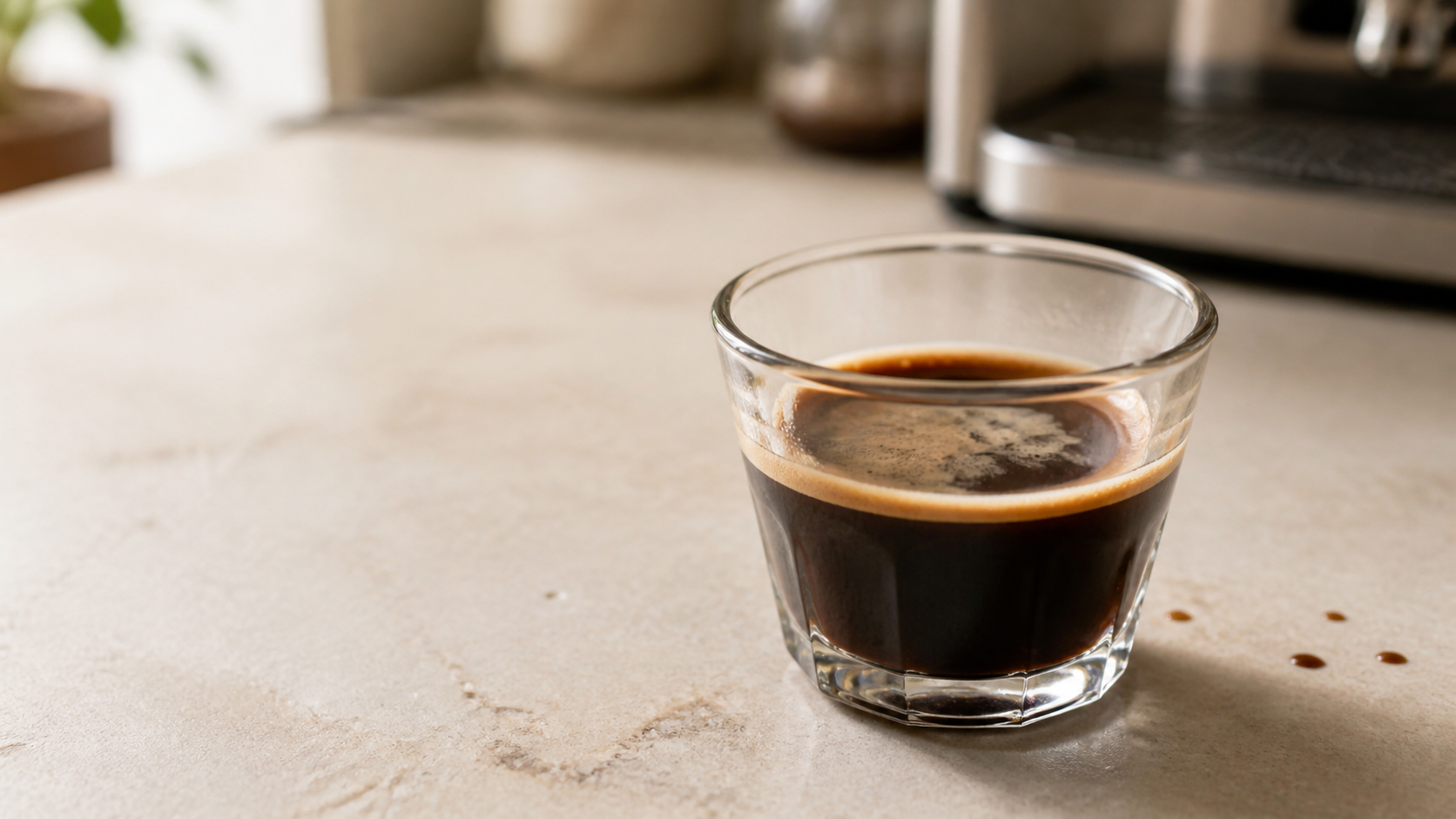
What Crema Actually Is
Crema is a foam of carbon dioxide bubbles, produced during roasting and held in the bean until brewing, stabilised by emulsified coffee oils and by melanoidins — the brown compounds that give it its colour. Roasting drives chemical reactions that generate carbon dioxide inside the bean structure, and a surprising amount of it stays trapped there for weeks afterwards.
During the shot, the pump holds nine or so bars of pressure across the puck, and at that pressure the gas stays dissolved in the liquid. The moment the espresso exits the basket into a cup at ordinary atmospheric pressure, it can no longer hold that gas in solution. The carbon dioxide comes out as thousands of tiny bubbles, coffee oils coat them so they do not immediately burst, and melanoidins tint the whole layer that familiar hazelnut colour.
Everything crema does follows from that. It is thickest when the beans are gassy and thinnest when they are not, it needs pressure across the puck to exist at all, and it is temporary by definition — every foam eventually drains and collapses.
Fine particles matter here too, in a way that rarely gets mentioned. Barista Hustle's work on regrinding compared grinders under a microscope and reported that double grinding produced thicker, more stable crema with smaller bubbles, while burrs that generated very few fines gave noticeably less crema — and what little appeared disappeared much faster. The fines act as nucleation sites and as part of the structure holding the foam up.
Did Your Crema Vanish After an Upgrade?
If your crema disappeared the same week you bought a bottomless portafilter, a new basket or a better grinder, you did not break anything — you almost certainly stopped using a pressurised basket, and the thick foam you were used to was being manufactured mechanically rather than produced by your coffee. This is the single most common reason people search for this problem, and almost nobody explains it properly.
Most entry-level machines ship with a pressurised, or dual-wall, basket: a second layer underneath the visible one with a single small restrictor hole. Instead of leaving through dozens of fine holes across the whole face, the brew is forced through that one opening at speed, and the turbulence whips air into it on the way out. The result looks like crema regardless of what the coffee is doing — stale beans, far too coarse a grind, a puck full of channels. That is the design's purpose: it makes bad inputs forgiving, which is genuinely useful when you are starting out, and it is exactly why the foam tells you nothing.
| Pressurised (dual-wall) | Single-wall | |
|---|---|---|
| Underside | One small hole, or a plastic insert | Dozens of fine holes across the face |
| What makes the foam | A restrictor forcing flow through one opening | Carbon dioxide from the coffee itself |
| Responds to bean freshness | Barely | Directly and visibly |
| Responds to grind changes | Barely — hard to dial in | Yes, this is how you dial in |
| Works with a bottomless portafilter | No | Yes |
| Crema tells you | Nothing useful | How much gas the coffee still holds |
To find out which you have, pop the basket out of the portafilter and turn it over. One pinhole means pressurised. A face covered in fine perforations means single-wall. Every KNODOS bottomless portafilter ships with a single-wall 18–21g basket at $49.99, in 54mm for Breville and 58mm for Gaggia, E61 and Breville Dual Boiler machines, precisely because a bottomless portafilter and a pressurised basket cannot work together — there is no spout to build the restriction against.
Losing that foam is a step forward, not a fault: what you see now is the real signal, and it is the one you dial in against. Our guide to using a bottomless portafilter covers the rest of that transition.
Cause 1: The Beans Have Nothing Left to Give
If you have ruled out the basket, bean age is the most likely cause — carbon dioxide diffuses out of roasted coffee continuously, fastest in the first days after roasting, and beans past about a month have very little left to turn into foam. No amount of technique replaces gas that is no longer there.
This is physical freshness, not the chemical staling that changes flavour, and the two run on different clocks — coffee can taste perfectly pleasant while having degassed to the point where it produces almost nothing on top. The SCA's Expo Lectures podcast with researcher Samo Smrke, The Science of Coffee Freshness, is a good primer on the distinction.
| Days off roast | What to expect from crema |
|---|---|
| 0–3 days | Very gassy. Crema can be thick but unstable, and shots often run unpredictably fast |
| 4–21 days | The usual sweet spot — steady crema and predictable shot behaviour |
| 3–5 weeks | Thinning noticeably. Still drinkable, visibly flatter |
| Past 5 weeks | Little to no crema regardless of technique |
| Pre-ground | Gas escapes in minutes once ground — usually flat by the time you open the bag |
Two practical consequences. First, buy coffee with a roast date printed on it, not a best-before date; a best-before date tells you nothing about degassing. Second, how you store beans between roasting and brewing matters more than most people assume. A fully sealed container traps the carbon dioxide the beans are still releasing and builds pressure, which is why single-dose storage tubes exist. Our Walnut bean cellar set at $119.90 puts a one-way exhaust valve in each tube lid so carbon dioxide can escape while oxygen stays out; the $39.99 rosewood set uses plain airtight screw lids instead, so if the valve is what you are after, check which set you are looking at. We go through the whole topic in our guide to single dose storage.
Cause 2: The Shot Is Running Too Fast
Crema needs pressure across the puck to exist, and pressure only builds if the coffee bed resists the water — so a shot that pours out in fifteen seconds will be flat even with beans roasted yesterday. Grind size is the lever that sets that resistance, and it is the first thing to correct.
The mechanism is direct: too coarse a grind lets water through easily, the pump never builds working pressure, and the carbon dioxide leaves with the liquid instead of emerging as foam. You get a pale, thin, fast shot with a ring of bubbles that vanishes before you sit down. A standard reference for a double is roughly 18g in producing about 36g out over 25 to 30 seconds; if yours arrives well ahead of that, grind finer one step at a time and pull again. Changing dose, tamp and grind together tells you nothing about which mattered.
The same fast, pale shot usually tastes sour, because water that moves through too quickly has not dissolved enough of the coffee. Thin crema and a sour cup nearly always arrive together, and they have the same fix. Our guide to reading sour and bitter shots walks through the taste side of the same problem in detail.
One thing that does not help: getting water to the grounds before the shot. Barista Hustle's experiments with wet Weiss distribution found that pre-wetting the coffee with steam produced a shot that gushed out in seconds with virtually no crema at all, and that humidified coffee needed a finer grind and still gave much less crema. Releasing the gas early wastes it.
Cause 3: Channelling Is Venting the Gas Early
Channelling means water has carved a low-resistance path through a weak spot in the puck, and once it does, pressure drops across the whole bed — so the shot exits early, under-pressurised, and carries far less dissolved gas to turn into crema. The foam problem is a symptom; the puck is the cause.
Channels form for ordinary reasons: clumps left by the grinder, grounds mounded in the centre and thin at the edges, a tamp pressed in at an angle, or a tamper narrower than the basket leaving a loose ring of coffee around the perimeter. Any of these gives water somewhere easier to go than through the coffee.
It is worth separating from grind because the two look different in the cup: a coarse grind gives a uniformly fast shot, while a channelled one can hit roughly the right time yet taste hollow and sour, with crema that is patchy rather than thin — heavy on one side, absent on the other.
You cannot see any of this through a spouted portafilter, which is the real argument for a bottomless portafilter: it turns an invisible problem into something you watch happen, with jets firing sideways and the stream blonding early. Our step-by-step fix for a spraying portafilter is the companion piece to this section.
The fixes are all upstream of the shot. Break up clumps with a WDT tool — ours is $29.99 with interchangeable 0.4mm and 0.25mm needles — then level the bed with a distributor before tamping flat with a tamper that actually matches your basket diameter. Even distribution is worth more here than tamping harder.
Cause 4: Pressure, Temperature and the Machine
Machine faults are a real cause of missing crema but a much rarer one than the internet suggests, and they are worth checking only after beans, grind and puck preparation have been ruled out. The order matters, because chasing a pump problem that does not exist wastes weeks.
Around nine bars is the conventional brewing target, and a genuinely weak pump cannot hold the pressure that keeps carbon dioxide in solution. But a machine delivering perfect pressure will still produce a flat shot if the grind is too coarse — pressure needs something to push against, and the puck is that something. The two failures look almost identical from outside, which is why grind gets tested first. Temperature matters at the margin: brew water well below the normal range extracts sluggishly and gives a thin, sour shot with little foam, and on machines without temperature control, simply letting it come fully up to heat is most of the available fix.
Two mechanical checks are worth making because they are cheap. A shower screen caked with old coffee oils spreads water unevenly across the puck surface, which encourages channelling; wipe it regularly and backflush if your machine supports it. And a basket with worn or enlarged holes lets the shot through too easily — if a basket has been in daily service for years and shots have gradually got faster, replacing it can restore what you lost.
If you are not sure which basket and accessory sizes your machine takes, the machine finder matches parts to specific models.
Cause 5: Roast Level and Bean Species
Roast level and species change how much crema you get more than technique ever will, which is the clearest evidence that crema is a poor measure of a shot. Two people pulling identical, equally skilful shots from different bags will get visibly different results.
Darker roasts spend longer developing and generate more carbon dioxide inside the bean, so they arrive with more gas to give up. Light roasts are denser, less developed and start with less. This is why a modest dark roast blend routinely produces a thicker head than a carefully pulled light roast single origin that tastes far more interesting.
Species pulls in the same direction. Robusta typically gives a thicker, faster-forming crema than arabica, which is one reason traditional Italian espresso blends include a proportion of it. The nuance worth keeping is that more crema and better crema are different claims: arabica carries more lipids, and those oils are part of what holds a foam together. Volume and stability do not always move as one.
None of this is a reason to change what you buy — it is a reason to calibrate expectations to the bag in front of you. If you moved from a supermarket dark roast to a light roast from a local roaster and the crema thinned, that is the coffee changing, not your technique failing, and the cup is very likely better.
A Two-Minute Diagnostic
Work through these five checks in order and you will know which cause you are dealing with inside two shots. Each step isolates one variable, so resist skipping ahead to the interesting ones.
- Turn the basket over. One small hole or a plastic insert means a pressurised basket, and the crema question is answered before you start. Switch to a single-wall basket and start again from what the coffee actually gives you.
- Find the roast date. Not a best-before date. Past about five weeks, stop here — buy fresher coffee before changing anything on the machine.
- Time the shot. Weigh in, weigh out, watch the clock. Well under 25 seconds to reach double the dry weight means grind finer, one step, and pull again.
- Pull one shot through a bottomless portafilter. One even stream means the puck is sound. Jets, sideways spray or early blonding mean channelling, and the fix is distribution rather than the machine.
- Only now look at the machine. Steps one to four cover the overwhelming majority of cases. If all four are clean and shots are still flat, then pressure, temperature or a worn basket becomes worth investigating.
Step one is the one people skip, and it is the one that most often ends the search immediately.
Is Crema Actually a Sign of a Good Shot?
No — crema measures how much carbon dioxide the coffee still holds, and that tracks roast date, roast level and bean species far more closely than it tracks extraction quality or your skill. It is worth saying plainly, because a great deal of effort gets spent chasing a number that was never measuring the thing people think it measures.
Consider what actually moves it: a darker roast, fresher beans, robusta in the blend, and a pressurised basket that raises it while telling you nothing at all. None of those is quality, and one is a mechanical trick. Meanwhile a balanced shot from a light roast three weeks past roasting can arrive with a thin, quickly fading layer and taste better than anything the thick-crema bag produced.
Crema is not useless, though. Read as a signal rather than a score, it carries information: patchy, one-sided crema suggests channelling, and a shot that arrives fast and pale all the way through suggests under-extraction. Those are diagnostic observations that point somewhere. Thickness on its own does not.
The honest hierarchy is taste first, then weight and time, then everything else. If the shot hits your target weight in the expected window and tastes the way you want it to, it is a good shot. What is sitting on top of it is a description of the beans, not a verdict on the coffee.
Tools That Help — and Ones That Do Not
The tools that change crema are the ones that protect the gas in the coffee or keep the puck intact; nothing you can buy adds foam to coffee that has already degassed. Being clear about which is which saves money.
What helps, in the order it matters. Storage that vents carbon dioxide instead of trapping it, because bean freshness is the single biggest lever — that is the argument for one-way valve storage tubes. Then even puck preparation, because channelling wastes pressure: a WDT tool to break clumps, a distributor at $39.99 with adjustable depth to level the bed, and a calibrated tamper so the compression is the same every time rather than a variable you cannot see. And a bottomless portafilter, not because it improves the shot but because it shows you what is wrong with it.
What does not help, despite its reputation: the puck screen. Ours are ultra-thin stainless steel at $13.99 in 51mm, 54mm and 58mm and are genuinely worth owning, but they keep the shower screen clean and spread water evenly — they sit on top of the coffee and do not add gas to it. Any effect on crema is indirect. Our guide to what a puck screen actually does covers the real benefits. Also worth ignoring: anything promising to restore crema to old coffee. Once the carbon dioxide has diffused out, no accessory puts it back.
Common Mistakes to Avoid
- Judging a shot by its crema. Roast level and bean age move it far more than skill does. Taste, weight and time are the real measures.
- Panicking after an upgrade. Losing thick foam when you move off a pressurised basket is the expected outcome, not a fault. You are seeing the truth for the first time.
- Buying by best-before date. It tells you nothing about degassing. Look for a roast date, and treat anything past about five weeks as flat by default.
- Blaming the pump first. Machine faults are real but rare. Basket type, bean age, grind and channelling account for the overwhelming majority of cases.
- Wetting the grounds before the shot. Releasing the carbon dioxide early is exactly the wrong direction, and the tested result is a fast shot with almost no crema.
- Storing beans in a fully sealed jar. Trapped gas builds pressure and pushes stale air back into the beans when opened. Vented single-dose storage is the better answer.
Frequently Asked Questions
Why is there no crema on my espresso?
Crema is carbon dioxide that was trapped in the beans during roasting and comes out of solution when the shot leaves the basket. If there is no gas left in the coffee, there is no crema to form. The most common reason is beans that are too old, followed by a shot running too fast to build pressure, and channelling that vents the gas early.
Does no crema mean my espresso is bad?
No. Crema measures how much carbon dioxide the coffee still holds, which tracks roast date and roast level far more than it tracks quality or your technique. A well extracted light roast three weeks off roast can taste excellent with very little crema. Judge the shot by taste, weight and time in the cup, not by the foam on top.
Why did my crema disappear after switching to a bottomless portafilter?
Because you almost certainly changed basket at the same time. A bottomless portafilter is supplied with a single-wall basket, and the pressurised dual-wall basket you were using before was manufacturing foam mechanically through a restrictor. Losing that foam is not a fault. You are now seeing the real crema your coffee produces, which is the honest starting point for dialling in.
What is a pressurised basket and how do I know if I have one?
A pressurised or dual-wall basket has a second layer underneath with one small hole in it. Turn the basket over: a single small pinhole or a plastic insert means pressurised, dozens of fine holes across the whole face means single-wall. The restrictor forces the brew through one opening, which whips air into it and produces foam whatever the coffee is doing.
How fresh do beans need to be for crema?
Crema is usually strongest from roughly four days to three weeks after roasting. Degassing is fastest in the first few days, so very fresh beans can be gassy and unstable, while beans past a month have released most of their carbon dioxide and produce thin crema no matter how well you pull the shot. Buy with a roast date printed on the bag, not a use-by date.
Can old coffee ever produce crema?
Only a little, and it collapses quickly. Once the carbon dioxide has diffused out of the beans there is nothing left to form bubbles when the pressure drops. Darker roasts hold on marginally longer because they started with more gas, but no grind adjustment or tamping technique can put gas back into stale coffee.
Does robusta really make more crema than arabica?
Usually yes, in volume. Robusta tends to produce a thicker, faster-forming crema, which is why traditional Italian espresso blends include it. The picture is less simple than it looks, though, because arabica carries more lipids and those oils help hold a foam together. More crema and better crema are not the same claim.
Why does my crema disappear within a minute?
Crema is a foam held together by emulsified oils and melanoidins, and every foam eventually drains and collapses. Fast collapse usually points to older beans or to very few fine particles in the grind. Barista Hustle has reported that grinders producing fewer fines gave less crema, and what crema there was disappeared noticeably faster.
Does a puck screen affect crema?
Not directly. A puck screen sits on top of the coffee and helps water spread evenly across the surface while keeping the shower screen clean. Its effect on crema is indirect at best, through more even wetting and less channelling. Do not buy one expecting thicker foam.
Can channelling cause thin crema?
Yes. When water carves a path through a weak spot in the puck it exits early and at lower pressure, so less carbon dioxide stays dissolved in the shot and less of it emerges as foam. Channelled shots also tend to run fast and taste sour, so thin crema rarely arrives on its own. Pull one through a bottomless portafilter and you will see the jets.
Is pale or blonde crema a problem?
Pale crema at the start of the shot is normal. Pale crema across the whole shot, arriving fast and thin, usually means under extraction: the water moved through the puck too quickly to pick up much colour or dissolved gas. Grind finer and check that the shot takes the expected time to reach your target weight.
Does grind size affect crema?
Strongly. Grind sets the resistance the pump works against, and without resistance there is no pressure to keep carbon dioxide dissolved. A shot that gushes out in fifteen seconds will look flat regardless of how fresh the beans are. Grinding finer is the first correction to make before suspecting anything else.
Do I need nine bars of pressure to get crema?
Around nine bars is the conventional target, but the pressure only matters if the puck gives it something to push against. A machine can be delivering full pressure and still produce a flat shot if the grind is too coarse or the puck is channelling. Check your grind and puck preparation before assuming the pump is at fault.
Does a dark roast give more crema?
Generally yes. Longer roasting generates more carbon dioxide inside the bean, so darker roasts start with more gas available to form foam. This is one of the clearest reasons crema is a poor guide to quality: roast level changes it far more than skill does, and a darker roast will out-crema a carefully pulled light roast every time.
Does pre-ground coffee produce crema?
Rarely, and only if it is very recently ground. Grinding exposes an enormous amount of surface area, and carbon dioxide escapes from ground coffee in minutes rather than weeks. By the time a supermarket bag reaches your kitchen most of its gas is gone, which is why pre-ground espresso so often looks flat.
Will steaming or wetting the grounds before brewing help?
No, it does the opposite. Barista Hustle tested pre-wetting grounds with steam and reported that the shot gushed out in seconds with virtually no crema at all, and that humidified coffee needed a finer grind and still produced much less crema. Water reaching the grounds before the shot releases the gas early, where it does nothing for you.