
What Is an Espresso Tamping Station and Do You Need One? (2026)
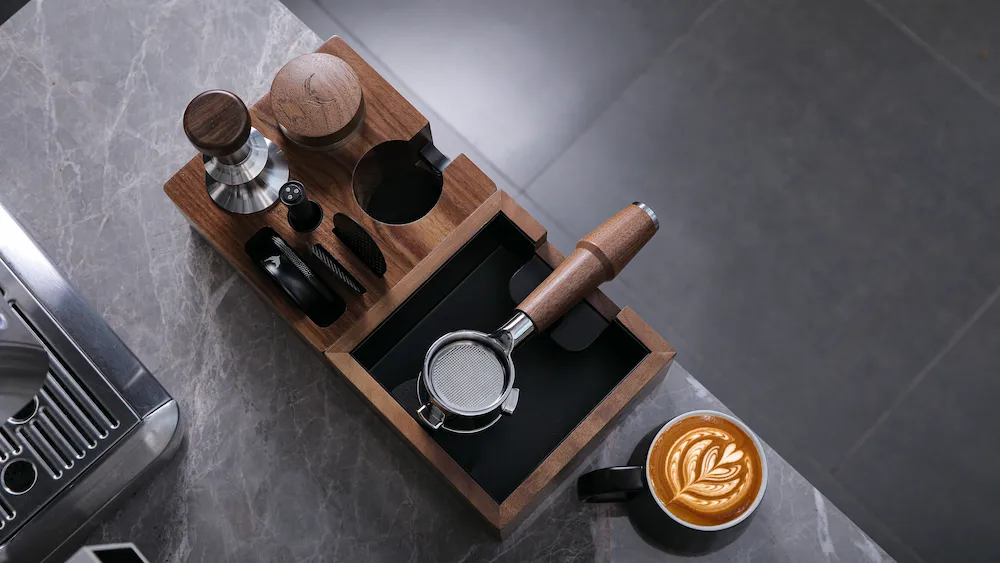
What Is an Espresso Tamping Station?
An espresso tamping station is a stand with a shaped cradle that holds your portafilter upright and steady while you tamp. Most stations also carry slots or holders for the tools you use at that moment — tamper, distributor, WDT tool, dosing funnel — so dosing, stirring, levelling and tamping all happen in one small, fixed area instead of scattered across the counter.
It is the least glamorous item in a home espresso setup and the easiest to dismiss. But consider what happens without one: you rest the portafilter on the edge of the counter or hold it in one hand, press down with the other, and hope the handle does not tip. The tamp is the last thing you do before the shot, and it is being performed on an unstable surface.
You will also see these sold as a tamper station, a coffee tamping station, or an espresso tool organiser. They all describe the same object: a cradle plus storage, built to anchor the puck-prep part of your routine.
What a Tamping Station Actually Does
A tamping station never touches the coffee, so it cannot improve extraction the way a better grinder or fresher beans can. What it improves is repeatability — and in espresso, repeatability is most of the battle.
It makes a level tamp the default
The goal of tamping is a flat, evenly compressed puck. Water pushed through the bed at around nine bars always takes the path of least resistance, so if one side is compressed harder than the other, water races through the softer side. That is channeling, and it is the usual reason a shot tastes sour and thin, or sprays from a bottomless portafilter.
Tamping level is harder than it sounds when the portafilter is unsupported. The handle is heavy and off-centre, so the moment you press, the whole thing wants to tilt toward the spout. A cradle removes that variable: the portafilter sits square, the stand carries the handle, and your hand only has to supply straight downward force. Barista Hustle has long argued that a level tamp matters more than how hard you press, and the Specialty Coffee Association treats even extraction across the bed as a foundation of espresso quality. A station is simply the cheapest way to make "level" automatic rather than something you concentrate on.
It protects your counter and your portafilter
Tamping directly on stone or laminate puts the full force of your body weight through the portafilter rim. A wooden cradle absorbs that and keeps metal off the worktop, which saves both the counter finish and the portafilter's edge.
It makes the tools get used
This is the underrated one. Tools you have to fetch are tools you skip on a rushed morning. When the WDT tool and distributor live in the station beside the machine, the full stir–level–tamp chain takes seconds and actually happens every time. A station does not just store tools; it changes whether you use them.
Do You Actually Need One?
Honest answer: a tamping station is a convenience and consistency upgrade, not a fix for bad coffee. If your shots taste wrong, a better grinder, fresher beans and correct dialling-in will move the needle far more.
You will notice a station most if:
- You pull shots daily and puck prep has become a routine rather than an experiment.
- You own three or more prep tools and they currently live in a drawer or scattered on the counter.
- You use a bottomless portafilter and are chasing down channeling.
- Your counter is stone or a finish you would rather not hammer a portafilter into.
You can skip it if: you pull the occasional weekend shot, own only a tamper, or your counter space is genuinely too tight for a fixed station. In that case a tamping mat covers the counter-protection half of the job for less money and less space.
Tamping Station vs Tamping Mat vs Knock Box
These three get confused constantly because they share the same patch of counter. They solve different problems and sit at different points in the workflow.
| Feature | Tamping Station | Tamping Mat | Knock Box |
|---|---|---|---|
| Main job | Holds the portafilter level and steady | Protects the counter surface | Ejects and collects the spent puck |
| When in the routine | Before the shot | Before the shot | After the shot |
| Portafilter support | Shaped cradle grips the basket | Flat pad, portafilter rests on it | Not applicable |
| Tool storage | Upright slots for tamper, distributor, WDT | Flat surface, or a low-profile rest | None |
| Helps level tamping | Yes — the handle is supported | Only indirectly | No |
| Footprint | Larger, a fixed station | Small, easy to stow | Medium, often beside the machine |
| Best for | Daily setups with several tools | Tight counters, minimal kit | Anyone pulling more than one shot a day |
They are not mutually exclusive — a station and a knock box cover opposite ends of the same workflow, which is why some stations build the knock box into the same block of wood. A mat, on the other hand, is largely redundant once you own a station.
What Size Tamping Station Do You Need?
This is the one specification you cannot get wrong. The cradle is cut to a diameter: a portafilter that is too small will rock in it, and one that is too large will not seat at all. Match the station to your portafilter, not to your machine's brand.
| Size | Machines |
|---|---|
| 51mm | DeLonghi Dedica, Smeg, Casabrews, La Pavoni and other 51mm home machines |
| 54mm | Breville and Sage: Barista Express, Barista Pro, Barista Touch, Barista Touch Impress, Bambino, Bambino Plus, Infuser, Duo Temp Pro |
| 58mm | Gaggia Classic and Classic Pro, Rancilio Silvia, Lelit, Rocket, Profitec, ECM, La Marzocco and all E61 group head machines |
Two notes worth knowing before you buy. First, 51mm is the size most brands skip, so the selection is thinner — check that the model you want is actually made in 51mm rather than assuming. Second, "54mm" and "58mm" describe the basket family, and Sage-branded machines in the UK and Europe are the same hardware as Breville in the US, so the same 54mm station fits both.
Not sure which your machine uses? The KNODOS Machine Finder gives you the exact portafilter size for your model.
What to Look For in a Tamping Station
A cradle that holds the basket level
Beyond diameter, look at how the portafilter sits. The basket rim should be horizontal when seated, because tamping into a tilted basket produces a sloped puck no matter how carefully you press. Some stations use an adjustable holder so the handle clears the counter while the basket stays flat.
Stability under load
You are pressing with real force, so the station has to stay put. Density matters — a hardwood body has enough mass to resist sliding, and an anti-slip base keeps it anchored on stone or laminate. A light, hollow station that shifts under the tamp defeats the purpose entirely.
Tool storage that matches your kit
Count what you actually use. A tamper alone needs very little, and a simple station with a single integrated tamper rest will do. But a tamper, distributor, WDT tool and dosing funnel together need real capacity — a seven-slot organiser, for example, gives every tool its own upright home so nothing gets laid flat on the counter with the business end in yesterday's grounds.
Material and finish
Wood is the standard for good reason: dense enough to stay planted, warm against a stainless machine, and it will not scratch the portafilter. Beech is pale and hard-wearing, walnut darker and warmer, rosewood deepest in tone. The choice is mostly about what sits well beside your machine — but check the finish is sealed, since bare wood stains quickly with coffee.
Whether you want the knock box built in
Some stations combine the cradle with a knock box, so prep and puck disposal share one piece of wood. It saves counter space and a step in the routine. The trade-off is that it makes the station a permanent fixture rather than something you can tuck away, and it costs more than a cradle alone.
How to Set Up and Use a Tamping Station
Step 1: Position the station
Put it on the counter beside the machine, on the side of your dominant hand, close enough to reach the group head without stepping away. The whole benefit is a compact prep zone, so anything that makes you turn or stretch works against it.
Step 2: Load the tool slots
Give each tool a fixed home — tamper in one slot, distributor in another, WDT tool within reach. Once tools have a place, you stop hunting for them and the prep chain becomes automatic.
Step 3: Seat the portafilter in the cradle
Drop the portafilter into the cradle so the basket sits level and the handle is supported by the stand. Grind your dose straight into the basket, using a dosing funnel if you tend to spill.
Step 4: Stir, level, then tamp
Stir the dose with a WDT tool to break up clumps, level the surface with a distributor, then tamp straight down. With the cradle holding everything square, you only have to think about pressing vertically.
Common Mistakes to Avoid
- Buying the wrong diameter. The most common error by far. Confirm your portafilter size before ordering — a 54mm cradle will not hold a 58mm portafilter, and a 58mm cradle lets a 54mm one rock.
- Assuming a station fixes bad prep. It steadies the tamp; it does not declump the grounds. You still need to stir and level.
- Putting it out of reach. A station across the counter from the machine adds steps instead of removing them.
- Leaning on the handle. Press down through the tamper, not across the portafilter handle — sideways force is what tilts the puck even in a cradle.
- Soaking the wood. Wooden stations are wiped, never submerged and never put in the dishwasher.
- Buying more slots than you own tools for. An empty seven-slot organiser is just a larger footprint. Match the station to your actual kit.
KNODOS Tamping Stations: The Range
KNODOS tamping stations are handcrafted from solid hardwood, with a stable portafilter cradle and integrated tool storage so the whole puck-prep routine has one home on your counter. The range works as a ladder, so you can match the station to how much kit you own and how much counter you can spare.
| Model | Price | Sizes | Best for |
|---|---|---|---|
| Walnut & Leather Tamping Mat | $39.99 | 54, 58mm | Tight counters, minimal kit |
| Classic Rosewood Tamper Station | $42.99 | 51, 54, 58mm | Cradle plus a tamper rest; the only route for 51mm on a budget |
| Beech Wood Station V3 | $49.99 | 54, 58mm | Seven-slot organiser, anti-slip base |
| Walnut Station V3 | $59.99 | 54, 58mm | Seven-slot organiser in darker walnut |
| Rosewood Station with Knock Box | $89.99 | 51, 54, 58mm | All-in-one prep and puck disposal, adjustable holder |
Shop by size
- 51mm (DeLonghi Dedica, Smeg, Casabrews) — Classic Rosewood Station · Station with Knock Box
- 54mm (Breville / Sage) — Beech V3 · Walnut V3 · Classic Rosewood · With Knock Box
- 58mm (E61, Gaggia, Rancilio, Lelit, Rocket) — Beech V3 · Walnut V3 · Classic Rosewood · With Knock Box
Browse the full tamping station collection, or find everything that fits your machine with the Machine Finder.
A station is the piece that ties the rest together. Pair it with a calibrated tamper, a distributor and a WDT tool and the stir–level–tamp chain stops being a sequence you have to remember and becomes the way your counter is arranged. For a wider view of which tools suit your setup, see our guide on how to choose espresso accessories for your machine.
Frequently Asked Questions
What is an espresso tamping station?
An espresso tamping station is a stand with a shaped cradle that holds your portafilter upright and steady while you tamp. Most stations also include slots or holders for your tamper, distributor and WDT tool, so the whole puck-prep routine happens in one place instead of balancing the portafilter on the counter.
Do I really need a tamping station?
It is not essential, but it solves two real problems. A cradle holds the portafilter level so you can push straight down without the handle tipping, which makes your tamp more repeatable. It also keeps your tools together and within reach. If you tamp on the counter and your tools live in a drawer, a station is one of the most noticeable quality-of-life upgrades in a home setup.
Does a tamping station make your espresso better?
Indirectly, yes. The station does not extract coffee, but it makes a level, straight-down tamp much easier to repeat, and an even puck is what stops water channeling through one weak spot. The gain is consistency: your tamp becomes the same every time instead of varying with how you happen to be holding the portafilter.
What is the difference between a tamping station and a tamping mat?
A tamping mat is a flat pad that protects your counter and gives the portafilter somewhere to rest. A tamping station adds a shaped cradle that grips the portafilter and holds it level, plus upright storage for your tools. A mat protects the surface; a station stabilises the tamp and organises the workflow. Mats suit tight counters and minimal kits; stations suit daily setups with several tools.
What is the difference between a tamping station and a knock box?
A tamping station holds the portafilter while you prepare and tamp the dose, before the shot. A knock box is a container with a padded bar you strike the portafilter against to eject the spent puck, after the shot. They cover opposite ends of the workflow, and some stations combine both in one piece of wood.
What size tamping station do I need?
Match the cradle to your portafilter diameter. 51mm fits DeLonghi Dedica, Smeg, Casabrews and La Pavoni. 54mm fits Breville and Sage machines including the Barista Express, Barista Pro, Barista Touch, Bambino and Bambino Plus. 58mm fits Gaggia Classic, Rancilio Silvia, Lelit, Rocket, Profitec, ECM, La Marzocco and E61 group head machines.
Which tamping station fits a Breville Barista Express?
The Breville Barista Express uses a 54mm portafilter, so you need a 54mm tamping station. The same 54mm size fits the Barista Pro, Barista Touch, Bambino, Bambino Plus, Infuser and Duo Temp Pro, and applies to Sage-branded versions of these machines in the UK and Europe.
Which tamping station fits a Gaggia Classic?
The Gaggia Classic and Classic Pro use the industry-standard 58mm portafilter, so a 58mm tamping station is the correct size. The same 58mm cradle fits Rancilio Silvia, Lelit, Rocket, Profitec, ECM and any E61 group head machine.
Is there a tamping station for a 51mm DeLonghi Dedica?
Yes. 51mm stations exist and fit the DeLonghi Dedica, Smeg, Casabrews and similar machines, but the choice is narrower than at 54mm and 58mm because many brands skip the size. In the KNODOS range, the Classic Rosewood Tamper Station and the Rosewood Tamping Station with Knock Box are both made in 51mm.
How much does an espresso tamping station cost?
Wooden tamping stations typically run from around $40 for a simple cradle with a tamper rest to roughly $90 for an all-in-one station with a built-in knock box. Multi-slot organiser stations sit in between, around $50 to $60. Price mostly tracks the wood, the number of tool slots, and whether puck disposal is built in.
What tools should a tamping station hold?
At minimum the tamper. A fuller setup holds everything you touch between grinding and pulling the shot: tamper, distributor or leveller, WDT tool and dosing funnel. Count your tools before buying, because a station with one tamper rest will not tidy a four-tool workflow.
What wood is best for a tamping station?
Any dense hardwood works. Beech is pale, hard-wearing and understated; walnut is darker with a warmer grain; rosewood is the deepest in tone. All are dense enough to stay planted while you tamp, so the choice is mostly about what looks right beside your machine. What matters more than species is mass and a non-slip base.
Should the portafilter cradle be angled or flat?
A cradle that holds the basket level is what matters, because tamping into a tilted basket produces a sloped puck. Some stations use an adjustable or angled holder so the portafilter handle clears the counter while the basket stays flat. Whatever the shape, check that the basket rim sits horizontal when the portafilter is seated.
Where should a tamping station go on the counter?
Beside the machine, on the side of your dominant hand, close enough to reach without stepping away from the group head. The point of a station is to keep dosing, stirring, levelling and tamping in one small area, so a position that makes you turn or reach across the counter defeats the purpose.
How do you clean a wooden tamping station?
Brush loose grounds off after each session and wipe the wood with a barely damp cloth, then dry it. Do not soak it, put it in the dishwasher, or use harsh cleaners, as prolonged moisture can raise the grain and dull the finish. Treating the wood occasionally with a food-safe oil keeps it looking new.
Can you use a tamping station with a bottomless portafilter?
Yes. The cradle grips the basket rim and body rather than the spouts, so bottomless and spouted portafilters both sit securely. A station pairs particularly well with a bottomless portafilter, because bottomless shots expose channeling and a steadier, more level tamp is one of the fixes.
Can you make a DIY tamping station?
You can improvise with a folded towel or a cut-out block of wood, and it will protect the counter. What is hard to reproduce at home is a cradle machined to your exact portafilter diameter that holds the basket level under tamping force, plus the weight and non-slip base that keep the whole thing from sliding as you press.
Do you still need a tamping mat if you have a tamping station?
Usually not. A station already lifts the portafilter off the counter and gives it a fixed home, which is the job the mat was doing. Some people keep a mat elsewhere on the bar for knocking, resting a hot portafilter or catching grounds, but the two are alternatives rather than a set you need to buy together.